Every conversation about self-hosting eventually lands on the same question: is a personal AI server actually cheaper than just paying for a cloud subscription? The answer is not a simple yes or no, because it depends on how much you use AI, what you use it for, and how long you keep the machine. This page breaks down the real numbers — up-front hardware, ongoing electricity, and total cost of ownership — so you can run the math for your own situation instead of trusting a slogan.
The Two Curves
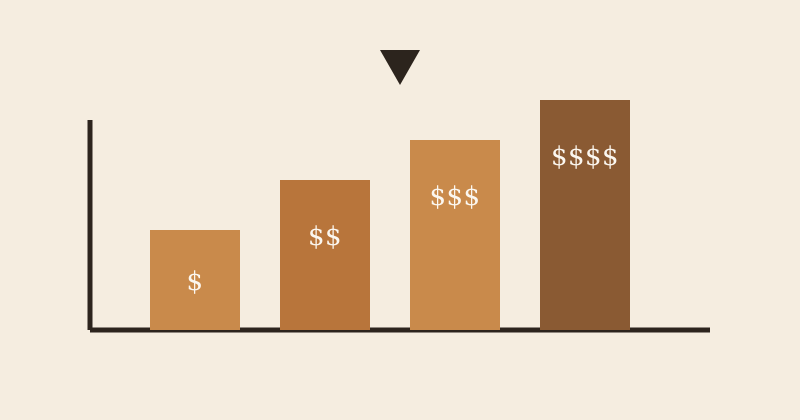
Think of the comparison as two lines on a graph. The cloud subscription line starts at zero and climbs steadily — a flat monthly fee, or per-token charges that grow with your usage. The self-hosted line starts high, at the full price of the hardware, then climbs very slowly, at the rate of electricity and the occasional upgrade. The two lines cross at some point, and everything after that crossing is money in your pocket.
Where that crossing happens depends entirely on your usage. For someone who occasionally asks a chatbot a question, the cloud line climbs so slowly that the crossing never comes — a subscription is cheaper. For someone who uses AI daily for work, coding, writing, and research, the cloud line is steep, and the crossing arrives within a year or two.
The people who benefit most from self-hosting are heavy users. Light users are almost always better off renting.
Up-Front Hardware Costs
The entry point is lower than most people assume, and the ceiling is as high as you want it to be. A capable starter machine — enough to run 7B and 13B models comfortably — costs roughly the same as a mid-range laptop. A serious daily-driver machine with a modern 24 GB GPU lands in the range of a high-end gaming PC. A multi-GPU enthusiast build crosses into used-car territory.
| Tier | Approximate cost | What it runs |
|---|---|---|
| Starter | $400–$700 | 7B–13B models, comfortable chat |
| Daily driver | $1,200–$2,000 | 13B–34B, coding and research |
| Enthusiast | $3,000+ | 70B-class, multi-user |
These are ballpark figures for building yourself; buying a pre-built or purpose-designed unit shifts the numbers somewhat but lands in the same neighborhoods. The hardware guide breaks each tier down component by component.
Electricity: The Forgotten Line Item
The cost most people forget is electricity, and for an always-on server it is the one that never stops. A machine's power draw comes in two flavors: idle, when it sits waiting, and load, when it is actively generating. For a personal AI server, the idle draw matters enormously, because the machine is on far more than it is generating.
A modest server might idle at 50–100 watts. Run 24 hours a day, that is roughly 44–88 kilowatt-hours per month. At typical residential electricity prices, that translates to a meaningful but not frightening monthly cost — on the order of a streaming subscription, not a car payment. A larger multi-GPU machine can triple that or more, which is when the electricity bill becomes a real line in your budget.
This is one reason the "small and efficient" path is worth considering even if you can afford more. A low-power machine that covers 80% of your needs at a fraction of the electricity cost is often the financially smarter choice than a monster that covers 100%.
Comparing to Cloud Costs
Cloud AI pricing splits into two models. Flat subscriptions — a fixed monthly fee for unlimited or capped usage — are easy to reason about. Per-token API pricing is harder, because the bill scales invisibly with how much you actually use, and heavy months can produce unpleasant surprises.
For a concrete comparison, take a power user who would otherwise pay $20–$30 per month for a subscription and also burn through API credits on top. A $1,500 self-hosted machine with a $10 monthly electricity cost breaks even in roughly a year and a half, and everything after that is effectively free. Stretch the hardware's life to four or five years — which is realistic for a well-built server — and the savings are substantial.
Total Cost of Ownership, Honestly
A fair comparison has to include the hidden costs on both sides. Self-hosting costs your time — setup, maintenance, upgrades — which has real value if your time is limited. Cloud services cost your flexibility and your data, which are harder to price but no less real. Neither side gets a free pass.
Our honest read is this: if you are a heavy, daily user who values privacy and owns their time, self-hosting wins on pure economics within a couple of years. If you are a light, occasional user, or if your time is more expensive than your money, a subscription is the rational choice. Most people land somewhere in the middle — and the middle is exactly where a modest local server shines.
The Cost of Not Owning
There is one cost that never appears in a spreadsheet but keeps showing up in the real world: the cost of dependence. When your AI workflow depends on a vendor, you inherit every pricing change, every model deprecation, and every policy shift. We have watched people build entire workflows on a specific hosted model only to have it removed, repriced, or altered in ways that broke their work.
A personal AI server does not immunize you against change — hardware fails, software changes — but it removes the single point of failure that is another company's business decisions. That resilience has economic value, even if it is impossible to put a precise number on it.
Making the Call
So, should you buy a personal AI server? The decision comes down to three questions. Do you use AI enough that subscription costs are becoming a real monthly expense? Do you work with material sensitive enough that local processing matters? And do you have the time to set up and maintain a machine? Two yes answers out of three, and self-hosting is likely worth it for you.
If you have decided the math works, the hardware guide is the place to start. And if you would rather buy a finished machine than build one, there are purpose-built options — clawbox.com is one vendor in this space worth a look — that trade some savings for a lot of saved setup time.
Worked Example: A Real Budget, Real Numbers
Abstractions are useful, but a concrete example is better. Let us price out a realistic daily-driver setup and compare it to a typical cloud subscription over a four-year horizon.
Assume a machine that costs $1,500 to build: a modern 24 GB GPU, an eight-core CPU, 64 GB of RAM, and a 2 TB SSD in a decent case. It idles at around 90 watts and draws around 350 watts under full inference load. If it runs around eight hours of active generation per week and idles the rest of the time, the average draw works out to roughly 120 watts — about 87 kilowatt-hours per month. At a typical residential rate of $0.15 per kilowatt-hour, that is about $13 a month in electricity.
On the cloud side, assume the same user would pay $20 per month for a flat subscription plus, conservatively, another $15 per month in API usage for heavier tasks — $35 a month total. That is a low estimate for a genuinely heavy user, but it keeps the comparison fair.
The math: the self-hosted machine costs $1,500 up front plus $13 a month. The cloud option costs $35 a month with no up-front cost. The self-hosted machine becomes cheaper at around the two-year mark, and by the end of four years it has saved its owner on the order of $700 — even before accounting for the privacy benefits and the fact that the hardware still has resale value. And that is a conservative example; a heavier user, or one in a country with pricier electricity, shifts the numbers further in each direction respectively.
Resale Value: The Overlooked Asset
People rarely factor in resale value, and they should. A well-chosen GPU retains a surprising fraction of its price for years, because the used market for AI-capable cards is deep and liquid. Unlike a subscription, which leaves you with nothing when you stop paying, a self-hosted machine leaves you with hardware you can sell, repurpose, or hand down. A machine that cost $1,500 might return $400–$600 after four years, which meaningfully improves the already-favorable math.
The same is true of the skills. Building and running a server is knowledge that compounds — it transfers to your next build, to troubleshooting other machines, and to a deeper understanding of the tools you use every day. Subscriptions teach you to swipe a card; self-hosting teaches you how the machine works.
Hidden Cloud Costs
The cloud comparison is usually framed as a clean monthly fee, but the real costs hide in the details. Per-token pricing scales invisibly with usage, and heavy months produce bills that arrive as a surprise. Many services price premium models and longer context windows at a substantial multiplier, so the "unlimited" plan you signed up for quietly steers you toward add-ons. Overage fees, storage for uploaded files, and premium tiers all nibble at the headline price.
None of this makes cloud services bad — for light users they are genuinely cheaper and easier. It simply means the honest comparison is between your actual cloud spend over a year, not the sticker price you remember signing up for. Most heavy users, when they total it honestly, find they have already spent a significant fraction of a server without noticing.
The Psychological Cost, Briefly
There is one more cost worth naming, because it shapes real decisions even though it does not fit a spreadsheet: the mental overhead of a meter running. When every request carries a per-token price, you ration your own curiosity. You think twice before asking the model to explore an idea, because exploration has a literal cost. A local server removes that meter. Once the machine is paid for, the marginal cost of the thousandth question is the same as the first: essentially nothing. For people who use AI as a thinking partner rather than a vending machine, that freedom changes how they work.
Is that worth the up-front cost? For some, decisively. For others, not at all. Only you can weigh your own curiosity against your own budget. But it belongs in the calculation, because it is real.
Final Verdict
To close with a clear answer rather than a hedge: for a heavy, daily user who values privacy and plans to keep the machine for several years, a personal AI server is the cheaper option over its life — often by a wide margin, and always with benefits that do not show up in the price. For a light or occasional user, a cloud subscription is the rational choice, full stop. The two groups are easy to tell apart: if your monthly AI bill is a line you actually notice, you are probably in the first group.